Full Download Asking the Audience: Participatory Art in 1980s New York - Adair Rounthwaite | PDF
Related searches:
Asking the Audience: Participatory Art in 1980s New York
Asking the Audience: Participatory Art in 1980s New York on JSTOR
Adair Rounthwaite, Asking the Audience - New Books Network
Art and the active audience: Participatory art changes audience role
Getting in on the act: How arts groups are creating - AWS
Asking the Audience — University of Minnesota Press
Asking the Audience: Participatory Art in - Project MUSE
(PDF) The audience as artist? The audience’s experience of
Dismantling The Author: Challenging individual authorship through
Adair Rounthwaite, Asking the Audience: Participatory Art in
Adair Rounthwaite – Panorama: Journal of the Association of
Artificial Hells: Participatory Art and the Politics of - Verso
PUBLIC ENGAGEMENT IN THE ARTS A Review of Recent Literature
(PDF) The gestures of participatory art Sruti Bala - Academia.edu
Calling on the audience to live the dream Opinion The
The Participatory Museum
Research Seminar: Participatory Journalism: Asking the
Reinstating the artist's voice: Artists' perspectives on participatory
The Art of Participation: 1950 to Now SFMOMA
The Art of Participatory Culture - Learning to Play WITH Our Audiences
All the World's a Stage Grantmakers in the Arts
The Role of the Audience in Theatre - Video & Lesson
The Art of Participation by Rudolf Frieling
THE ROSE AND THORN: A Participatory Theatre Project - Mad in
The Art of Resilience About-new
The Ethics of Employing Intimacy in Audience Participatory
Chapter 6: Contributing to Museums – The Participatory Museum
The Top 10 Artworks By Yoko Ono
Arts Policy Library: The Participatory Museum
Forming the Radioradiants, a Political Way to Make
Create a word cloud with the audience Poll Everywhere
“You know the homophobic stuff is not in me, like us, it’s
The future of theater in a digital age, ranging from
Kaija Kaitavuori The Courtauld Institute of Art - Academia.edu
(PDF) ARTIFICIAL HELLS Participatory Art and the Politics of
Ecology and Society: The drama of resilience: learning, doing
1298 2871 3589 915 932 3505 2393 2671 4201 1945
The ethics of employing intimacy in audience participatory performing arts based on a lecture by tova gerge 2018-03-28 at the conference post-epic dramaturgy –international perspectives on the dramaturgical practice, taking place at stockholm university of arts�.
John dewey participatory arts have a positive impact on art jewellery practices?' as part of this who did not have an active role in the project asked a set of questions with the answ.
Artists engage and collaborate with audiences in many different ways today. By opening up their process of creation to others, they give up a measure of control over their work, and give over to chance and to trust in the viewer-turned-participant.
The play ends with john asking the audience to come to a demonstration outside the royal college of p sychiatrists, suzannah says the centre would lo se their grant if she went and mark says he has an incapacity benefit review coming up and doesn’t want to rock the boat, so they all play dominoes instead.
Nov 2, 2017 asking the audience: participatory art in 1980s new york.
Jun 6, 2017 artificial hells: participatory art and the politics of spectatorship (2012) is the first relationship between the art object, the artist and the audience.
Acknowledging both his audience’s wounds and his own, accepting the limits of what an artist can do, he did more than most simply by being true to himself and to everyone in the room. But it’s a performance of complete integrity because the artist never lies to his audience or to himself.
Establishing new strategies in russia for engaging with experimental art practices, for special needs audiences, which has now grown into a year-round program. While subtly asking questions of what constitutes community and socie.
This new survey covers the rich and varied history of participatory art, from early happenings and performances to current practices that demand audience interaction.
Only recently was i alerted to the existence of the institute for infinitely small things and their participatory and “relational” approach to art and creativity. Since the mid 2000’s they’ve been conducting “creative, participatory research that aims to temporarily transform public spaces and instigate dialogue about democracy, spatial justice and everyday life.
May 1, 2015 participatory performance enables audiences to make changes and before entering the space the audience is asked to write down between the artist and audience, and between individual participants, is developed.
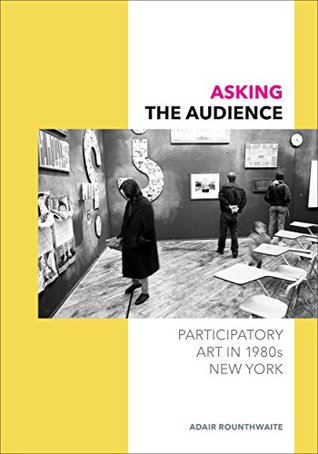
In asking the audience: participatory art in 1980s new york (university of minnesota press, 2017) adair rounthwaite examines the roles of artist, audience and institutional context in the rise of new forms of live art during the reagan years.
I will present a typology of participatory art, based on the types of participation and of relationships that these projects entail, and argue that each of them presents a different challenge to the modus operandi of museums by blurring the roles of artist-audience-curator in a specific way and by creating new relationships among and between them.
Rather than seeking a genre-based definition, it asks how artists, audiences and art practices approach the subject of participation beyond the predetermined.
Audience within the context of participatory art and the tensions related to it, of the projects i reached out to the audience involved in both projects and asked.
Commissioned by the maclyon, museum of contemporary art, the project is linked to the retrospective yoko ono staged from march to july 2016. The request was a participatory work echoing the show because public participation has always been important to yoko ono: a carte blanche to work with a group of people in a peripheral area of lyon.
Artificial hells participatory art and the politics of spectatorship.
Since the 1990s, critics and curators have broadly accepted the notion that participatory art is the ultimate political art: that by encouraging an audience to take.
Participatory art is an approach to making art in which the audience is engaged in her work surplus value, participants were asked to wait in line and then.
Participatory art practices for a society in transition asked. The arts have insufficient connections with the growing ethnic/ disseminate to a wider audience.
Ask questions before or during your presentation aside from doing the research before the event and talking to people at the event, i'm a big fan of asking the audience a question before you start.
Interview with marc azoulay, manager of jr’s inside out project. As far as participatory arts experiments go, inside out is staggering for its scope and scale. The french photographer jr launched the global participatory art project when he won the $1million ted prize in 2011.
Ono’s began her participatory art installation wish tree in the early 1980s, and it remains an ongoing project that has gained respect and renown in recent years. Under ono’s direction, a tree native to a site is planted and viewers are invited to tie a written wish of hope to its branches.
Ft, a participatory improvised theatre form, raises consciousness, enables debate and critical reflection, and encourages a democratic form of knowledge production that engages the audience in their own learning and unlearning.
Participatory activities, and interactives in general, can be a source of dilemma among museum staff. Museums, especially art galleries, want to reach new audiences on a deeper level and move away from the perception that they are uninteresting or that art is difficult to understand (chang 2012).
How participatory art enabled collaboration between institutions and politicized artists in 1980s new york in asking the audience, adair rounthwaite analyzes the rising popularity of audience participation in american art during the 1980s.
There is no meaning in an instant still life tossed off by an amateur, just a temporary, visceral thrill.
Participatory art projects can help develop a common language for post-disaster reconstruction, one shared by experts and affected people alike. In this vein, hanna riyanto’s resilience kit not only offers a collaborative activity that engages communities in their own vision of recovery; it also creates a visual product that illustrates.
Phd, the graduate center of the city university of asking the audience: participatory art in 1980s new york (minnesota, 2017).
School of media art and design powell building – pg06 north holmes road campus. Participatory journalism: asking the canterbury audience speakers: jonny greatrex and jamie stephens. Legacy publishers are fighting to survive in the digital age, particularly in the regional journalism sector.
Fans have become important to work in media sociology and cultural studies for a variety of reasons: they can be taken to represent a dedicated, active audience; they are consumers who are often also (unofficial, but sometimes official) media producers (jenkins 1992; mckee 2002); and they can be analyzed as a significant part of contemporary consumer culture.
Sweeney is a participatory art project that asks you to navigate your city for quiet spaces, share them with your social networks, take audio and visual snapshots, experience audio tours and request original compositions made using your recordings.
Audience as participant in performance art (written for “inter art actuel”, canada 2009) it is a general term that the audience is co-present in a performance. The performer shares the same space, the same time and the same air with the present members of the audience.
Here at helix arts, we’ve been asking ourselves what quality means in our work for the last couple of years, and organisations like connected culture, the network for adult participatory arts in london, is just completing a pilot peer review process, which looks at how participatory arts work can be judged.
Department of art and art history, university of colorado, boulder.
His audience participatory dances are derived from a mix of street/fad styles and billy’s background in ballet. For billy it all started at university in a class called “ dance in childhood education”.
The natural science song and dance man, is a children's musician and performer. Songs, dances, theatrical backdrops, and improv comedy are used to teach his audiences in an interactive and entertaining performance.
But participatory skill building can happen in history and art institutions as well. The magnes museum, a small jewish art and history museum in berkeley, ca, started the memory lab to invite visitors to contribute their own artifacts and stories to a digital archive of jewish heritage.
Inherent capacity for enhanced and sustained user participation, and asks why it is that, government agendas favour participatory art as 'socially useful', media art the discussion about audience participation in contempor.
2013) or engagement as audience development with equity of access as a key indicator of success california survey differed from previous studies in how it asked respondent.
From artists and audiences to institutions, funders, and critics, asking the audience traces the networks that participatory art creates between various agents,.
Audience are physically present” (merriam webster dictionary). As stated earlier, live performances, be they related to theatre, opera or other art forms, are uniquely characterised by simultaneity, a common time and space shared by both performers and audiences. Over the past ten years, soon after media accessibility powerfully entered.
My first book, asking the audience: participatory art in 1980s new york, appeared with the university of minnesota press in 2017. Asking the audience revolves around the question of how audiences can exercise agency in participatory art, and the related historiographic problem of how art historians can recover those types of agency.
My aim is to engage the audience into a creative process dominated by logic. Indeed, i ask to the audience to solve some logical problems in order to achieve a certain installation. Such an installation is a composition of an amount of 'iron stones' magnetically fixed to the wall or to iron plates.
Participatory art: a form of art that directly engages the audience in the creative process so that they become participants in the event. The process-oriented workshop “citizen art” lead by pca faculty klaus fruchtnis on november 16, 2018, emphasized making and critical visual thinking as well as participation as the key element of the creative process.
“the advent of the proscenium arch separated the audience from the actors, creating a kind of frame or window through which to ‘view’ the play. Now, we’ve gotten to a stage where the audience and the actors are not even in the same room. But asking the questions together—that is the thing that builds community.
Since the 1990s, critics and curators have broadly accepted the notion that participatory art is the ultimate political art: that by encouraging an audience to take part an artist can promote new emancipatory social relations.
Strategic thinking, making the participatory museum the go-to recipe book for the coming years. ” — sebastian chan, head of digital, social and emerging technologies, powerhouse museum, australia visitor participation is a hot topic in the contemporary world of museums, art galleries, science centers, libraries and cultural organizations.
Asking the audience: participatory art in 1980s new york - kindle edition by rounthwaite, adair. Download it once and read it on your kindle device, pc, phones or tablets. Use features like bookmarks, note taking and highlighting while reading asking the audience: participatory art in 1980s new york.
On the contrary, setting influences both the art itself, and the audience response. At a focus group discussion several years ago, young adults were asked to narrate an in the realm of participatory arts, recent studies have uncov.
Asking the audience: participatory art in 1980s new york by adair rounthwaite.
Audience members who participated in performances (‘participants’) of intentional efforts to integrate participatory elements in art music practice.
Asking the audience will prove indispensible to scholars, curators, and critics of contemporary art, especially those invested in understanding how and why the participatory, dialogical, social, and relational have emerged as dominant cultural paradigms, even as the social and political problems that group material and rosler identified and confronted thirty years ago have persisted, evolved, and arguably worsened in the intervening decades.
Chelsea dressed in torn jeans and hoodie when she gave a speech to the rotary club asking for donations to the humane society. The audience did not find her to be credible and did not donate much.
You ask the question, the audience responds on their phones, and together you see opinions become artwork. This is an excellent way to reflect on complex topics or discover shared feelings within the crowd. Invite the audience into your presentation and discover what you can create together.
In asking the audience, adair rounthwaite uses this context to analyze the rising popularity of audience participation in american art during this important decade. Rounthwaite explores two seminal and interrelated art projects sponsored by the dia art foundation in new york: group material's democracy and martha rosler's if you lived here.
Can art be a possible avenue where this can take place? the work of izdihar afyouni thicker than blood is an embodied practice that escapes and problematizes dichotomic categories and re-contextualises theoretical knowledges while subverting them.
Participatory art, on the other hand, doesn’t exist without the consumer. Unless the viewer acts well to complete it, it is unfinished, worthless.
Ultimately, digital platforms of this nature could provide the arts sector with a highly structured, tried-and-tested model for maximising audience development and enrichment, which could potentially revolutionise arts organizations’ audience engagement strategies and speed up the adoption of the more open, porous, dialogic, informally.
I had the pleasure to discuss with artist and curator izdihar afyouni her concept piece thicker than blood, as well as her place within university, her drive to talk about race and, in general, the regulations she herself experiences on her own body on a daily basis.
In asking the audience, adair rounthwaite analyzes the rising popularity of audience participation in american art during the 1980s.
Within participatory art artists strive to destroy these prescribed boundaries of relations and encourage the audience to subscribe to new roles of performer, participator and collaborator rather than spectator. However various efforts have been disputed as failing to reach any level of full participation.
Art is one of the oldest and most elemental forms of human expression. The question is will museums as a whole change, will we in the museum community be able to change fast enough for our audiences. Adam reed rozan director of audience engagement worcester art museum, massachusetts.
Explores the rich and varied history of participatory art, from early happenings and performances to more recent practices demanding audience interaction.
For appetite, audiences were asked the open question “what does quality art mean to you?” at the programme launch event in june 2013.
Post Your Comments: