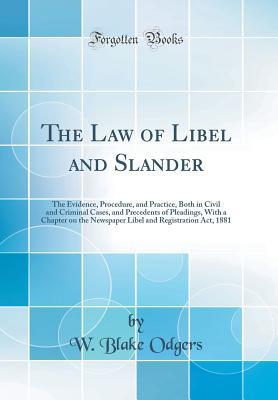
Full Download The Law of Libel and Slander: The Evidence, Procedure, and Practice, Both in Civil and Criminal Cases, and Precedents of Pleadings, with a Chapter on the Newspaper Libel and Registration Act, 1881 (Classic Reprint) - William Blake Odgers file in ePub
Related searches:
A Digest of the Law of Libel and Slander: With the Evidence
The Law of Libel and Slander: The Evidence, Procedure, and Practice, Both in Civil and Criminal Cases, and Precedents of Pleadings, with a Chapter on the Newspaper Libel and Registration Act, 1881 (Classic Reprint)
The Differences Between “Defamation,” “Libel” and “Slander”
Can Trump Change The Constitution? Libel Laws Are Pretty Hard To Mess With
Libel, Slander, and Defamation Law: The Basics - FindLaw
Libel and Slander The First Amendment Encyclopedia
Libel And Slander Protected By The First Amendment Law
Libel and Slander - The Public Figure Doctrine: An Unworkable
Libel and Slander - The Basic Law In California Stimmel Law
The Difference Among Defamation, Libel, and Slander Law Shucks
The History and Theory of the Law of Defamation. I - JSTOR
In the law of libel and slander malice legal definition of in
The Libel - Slander Distinction and the Indian Law - Indian
Libel and Slander - The New York Times
THE LIBEL AND SLANDER ACT
The Law of Libel and Slander in Civil and Criminal Cases: As
The Basics of Defamation, Libel, and Slander for California
Libel and slander - definition of Libel and slander by The
The Law of Slander and Libel: Including the Practice
In the law of libel and slander malice Article about in the
Defamation, Slander and Libel: The Basics
Defamation, Libel and Slander - The UAE Perspective - STA Law
Libel and Slander - Richard Jewell And The Olympic Park
Defamation, Slander and Libel Nolo
Defamation, Libel and Slander Meanings and Differences
Cyber Libel: Defamation Law and Examples of Online Defamation Nolo
Elements of Libel and Slander - FindLaw
Present Your Case - Free - Quick And Painless Process
Defamation, Libel and Slander Attorneys Traverse Legal
Defamation 101: Libel and Slander - Paullin Law Firm
Defamation: libel and slander - Court Stage - Enforcement Guide
Slander And Libel Law - Libelous/Slanderous Statements
Legal Elements of Libel and Slander - Defamation Law AllLaw
Defamation: Understanding Libel and Slander TheLaw.com
Libel and Slander Digestible Notes
Find Libel And Slander on eBay - Seriously, We Have Everything
CIVIL PRACTICE AND REMEDIES CODE CHAPTER 73. LIBEL
Libel and Slander Act, R.S.O. 1990, c. L.12 - Ontario.ca
Unfettered Press: Libel Law in the United States - About the USA
Defamation (Slander and Libel) New York Commercial Litigation
§ 18.2-417. Slander and libel - Virginia Law
Slander And Libel Meaning - Libelous/Slanderous Statements
Defamation Law - Guide to Libel and Slander Law - HG.org
When to Sue for Defamation, Slander, and Libel
A Guide To Slander Or Libel In Florida The Lopez Law Group
Defamation: Libel and slander - FREE Legal Information Legal Line
Defamation, Libel, Slander, and Cybersmearing Chicago Business
Summary of defamation, libel and slander law in Virginia
Libel, slander and online defamation - Lawbriefcase
DEFAMATION, LIBEL AND SLANDER LAW IN CYPRUS - Fellas
Defamation of Character: The Fundamental Elements of Libel
Defamation - Libel and Slander Laws AllLaw
Libel vs Slander - Difference and Comparison Diffen
Defamation: Libel and Slander ExpertLaw
Defamation: Libel and Slander Office of Justice Programs
California’s Defamation (Libel and Slander) Laws and Penalties
Find a Lawyer - Fast, Free, And Confidential
Slander And Libel Laws - Libelous/Slanderous Statements
Examples of Slander and Libel Including Real-Life Cases
3555 500 228 798 1992 530 4369 510 3011 1273 3035 4934 4220 4948 4980 2076 752 3894 771 2408 3490 320 1622 2490 4539
Libelous statements refer to words that can be seen (typically written and published), while slander occurs when a defamatory statement is spoken or otherwise audible (such as a radio broadcast).
For a statement to be considered libel or slander it must be untrue. Put another way, truth is always an absolute defense to a claim of libel or slander. In our hotdog example, if hot dogs r us does actually undercook their hotdogs, then making a statement to that effect is not defamatory.
The term “ defamation ” means any action or other proceeding for defamation, libel, slander, or similar claim alleging that forms of speech are false, have caused damage to reputation or emotional distress, have presented any person in a false light, or have resulted in criticism, dishonor, or condemnation of any person.
Libel and slander libel refers to permanent defamatory statements, which are rather in written format and widely broadcasted. T the ‘permanence’ requirement does not mean forever but rather it means that the communication of the statement lasted for more than a longer time till the original message is communicated.
At common law, defamation actions were divided into two categories, libel and slander. Libel and slander both involve the making of false statements, but the term libel refers to written defamation, while slander refers to non-written defamation: slander involves the making of defamatory statements by a transitory (non.
Libel is a written defamatory statement, and slander is a spoken or oral defamatory statement. In this article, we'll look at where you might find a defamatory statement, provide some different examples of libel and slander, and more. (for an overview of this area of law, check out defamation law made simple.
In a lawsuit for defamation (libel and slander) the existence of malice may increase the judgment to include general damages. Proof of malice is absolutely necessary for a public figure to win a lawsuit for defamation.
Libel and slander rules; common law privileges; damages and other remedies; invasion of privacy; emotional distress; injurious falsehood; negligent publication.
Slander, defamation and libel are all treated the same in virginia. Defamation is a false statement of fact published or communicated to another person that causes injury to the reputation of the subject of the statement.
Libel is published defamation of character, as opposed to spoken defamation of character, which is slander. Libel: exposes a person to hatred, shame, disgrace, contempt or ridicule. Injures a person’s reputation or causes the person to be shunned or avoided. Examples might include accusing someone of having committed a heinous crime, or of having a disease that might cause them to be shunned.
Both are covered by a general liability policy under personal and advertising injury liability. Frank renlie/getty images the terms libel and slander mean a false statement made by one person about.
Defamation is a false statement that is presented as fact and causes harm to the character of a person. Slander is an untrue, harmful statement that is spoken out loud. Libel is an untrue, harmful statement which is made in writing. Defamation law protects reputations of individuals and businesses.
Defamation: an unprivileged false statement of fact which tends to harm the reputation of a person or company.
News about libel and slander, including commentary and archival articles published in the new york times.
The damages slander and libel can cause when someone spreads false information about you, it can be hurtful to you both personally and professionally. Given the rise of social media, when people can easily communicate with hundreds or thousands of others with a single post, defamation cases are on the rise.
Libel and slander synonyms, libel and slander pronunciation, libel and slander translation, english dictionary definition of libel and slander. American heritage® dictionary of the english language, fifth edition.
Slander and libel go beyond just conveying false information about another person. When a person communicates falsehoods about another person that harm the person the lies are about, that can represent defamation in the form of slander or libel, depending on how the information is conveyed.
In order to determine the damages from a slander or libel suit, there must be quantifiable damages. Defamation of character damages a person’s or company’s reputation, and it must be proven that the damage to reputation correlated with a loss of money, property, relationship, or was subject to harassment that led to any of the above losses.
Both libel and slander are false statements made about one person by another person. Libel refers to a false statement made in writing, such as on a website or in a newspaper. Slander refers to a false statement that is spoken, rather than written. With the rise of the internet, slander could also refer to a statement made during an online chat.
In a lawsuit for defamation (libel and slander) the existence of malice may increase the judgment to include general damages. Proof of malice is absolutely necessary for a public figure to win a lawsuit for defamation. (see: malice aforethought, malicious prosecution, murder, defamation, libel, slander, public figure).
Under california law, it’s a broad term for false statements made that cause damage to someone’s reputation. Code) states that defamation is effected by either libel or slander.
The threat of the libel laws of some foreign countries is so dramatic that the united nations human rights committee examined the issue and indicated that in some instances the law of libel has served to discourage critical media reporting on matters of serious public interest, adversely affecting the ability of scholars and journalists to publish their work.
Slander is the act of making a false oral statement about the character or professional in defamation per se cases, a plaintiff does not need to prove damages.
⇒ defamation consists of two separate torts: libel and slander. ⇒ the main difference between them is that libel is the correct cause of action when the statement is in a permanent form; slander is where the statement is in transitory/temporary form.
The definitions of defamation libel and slander vary from state to state so it is important to know the laws of your particular state before embarking on any legal.
Libel and slander when someone publishes or communicates a false statement about you to another, the law provides a potential avenue for you to recover for damage to your reputation through laws preventing defamation (aka libel or slander). However, your level of public exposure can have a direct impact on your ability to recover.
Learn the differences between slander and libel defamatory statements. Libel is a written defamatory statement, and slander is a spoken or oral defamatory statement.
(law) law the injuring of a person's good name or reputation. Collins english dictionary – complete and unabridged, 12th edition 2014 © harpercollins publishers 1991, 1994, 1998, 2000, 2003, 2006, 2007, 2009, 2011, 2014.
Looking for in the law of libel and slander malice? find out information about in the law of libel and slander malice. In law, an intentional violation of the law of crimes or torts tort, in law, the violation of some duty clearly set by law, not by a specific agreement.
Where defamatory statements published via radio, television or the internet fit into these categories is not a clear-cut matter. For now, it may be easiest to think of slander as spoken defamation to a small audience (or just one other person) and libel as any written/posted defamation or spoken or video defamation to a large audience.
Libel is the publication of defamatory matter in permanent form. On the other hand, slander is the publication of defamatory matter in non-permanent form. Something defamatory that is printed in a newspaper or book was called libel, but the same thing, if spoken, was called slander.
If you are suing because your reputation was damaged due to a libelous statement, you do not have to prove.
Laws regulating slander and libel in the united states began to develop even before the american revolution. In one of the most famous cases, new york city publisher john peter zenger was imprisoned for 8 months in 1734 for printing attacks on the governor of the colony.
A libel is a defamation expressed in written or other graphic form that tends to blacken the memory of the dead or that tends.
California civil code defines libel as a false or unprivileged written statement or other fixed written representation which exposes a person to hatred, contempt, or ridicule, or which injures them in their occupation.
The common law distinctions between libel (printed defamatory statements) and slander (oral defamatory statements) have been largely abolished, and the rules.
The law of slander and libel: including the practice, pleading, and evidence.
In early 2021, smartmatic, a united states-based voter technology firm, filed a highly publicized defamation lawsuit against rupert murdoch’s fox news.
President-elect donald trump spent tuesday morning angrily tweeting at the new york times and broadcasting his cancellation of a planned meeting with the newspaper's editorial staff.
Libel refers to a written or oral defamatory statement or representation that conveys an unjustly unfavorable impression, whereas slander refers to a false spoken statement that is made to cause people to have a bad opinion of someone. This explanation is refreshingly simple, but perhaps because it is so simple many people fail to observe the nuance.
The term defamation is an all-encompassing term that covers any statement that hurts someone's reputation, also called defamation of character. If the statement is made in writing and published, the defamation is called libel. If the hurtful statement is spoken, the statement is slander.
Libel and slander both involve the making of false statements, but the term libel refers to written defamation, while slander refers to non-written defamation: slander involves the making of defamatory statements by a transitory (non-fixed) representation, usually an oral (spoken) representation. Libel involves the making of defamatory statements in a printed or fixed medium, such as a magazine or newspaper.
A digest of the law of libel and slander: with the evidence, procedure, and practice, both in civil and criminal cases, and precedents of pleadings [odgers, william blake, bigelow, melville madison] on amazon.
To conclude, libel and slander are virtually branches of defamation, an area of the law that protects individuals’ reputations by enabling them to recourse if false statements and accusations are made about them and affect their reputation negatively.
The basic difference between libel and slander is that libel is published defamation, while slander is fleeting, mostly verbal. In the court of law, both are considered defamation—that is, the communication of a false statement that harms the reputation of an individual, business, or group.
Generally, slander occurs when the reputation or good name of someone is damaged as a result of false.
The tort of defamation that refers to a false statement concerning a person or business that damages that person's or business's reputation.
The law thus evolved by no means covered all defamatory words; only certain specific imputations were.
When to sue for defamation, slander, and libel defamation of character is an offense for which a complainant may be eligible to bring another party to civil court. There are two types of defamation: spoken defamation, or slander, and written defamation, or libel.
Libel and slander are collectively known as defamation, or misrepresentation intended to harm the reputation of another person or entity.
Libel is a legal term that describes a written form of defamation, which the dictionary defines as a false or unjustified injury to someone's good reputation.
Libel and slander are types of defamation, meaning a statement that damages the reputation of a person or organization. To qualify as libel or slander, the false statement must be hurtful and cause harm to the other party.
Where defamatory statements published via radio, television or the internet fit into these categories is not a clear-cut matter. For now, it may be easiest to think of slander as spoken defamation to a small audience (or just one other person) and libel as any written/posted.
In florida, a statement amounts to defamation per se if it accuses the plaintiff of committing a crime or imputes to the plaintiff conduct, characteristics, or a condition.
Two torts that involve the communication of false information about a person, a group, or an entity such as a corporation.
Pursuant to article 138 of the brazilian penal code, slander consists of attributing a “criminal offense” to another person.
Although truth is the key defense in a defamation case and jewell was a suspect in the bombing, the libel action was based on more than just a statement of his status as a suspect. Listing 19 allegedly libelous headlines and excerpts from articles, the suit claimed that the newspaper libeled him in a series of false and defamatory articles.
Modern courts have eschewed the distinction between libel and slander opting instead for the catchall cause of action of defamation.
Libel is the publication of defamatory accusations in a permanent form and slander is the publication of abusive words in a temporary or momentary form (usually oral). There are three elements which a claimant must prove to sue the party for defamation.
Defamation of character is when someone makes a statement that damages your reputation. Slander and libel are included, and if it happens, it could ruin your.
In any action for defamation, it shall be lawful for apology.
On wednesday, as he's done several times before, president donald trump called for changes to the country's libel laws, insisting that news outlets have been publishing things that are knowingly false.
Defamation is an area of law that provides a civil remedy when someone's words end up causing harm to your reputation or your livelihood. Libel is a written or published defamatory statement, while slander is defamation that is spoken by the defendant.
Libel is one of those legal causes of action often considered as appropriate by the lay person but, in reality, a difficult and complex matter to allege and prove. When used in day to day language, most people consider it merely saying something untrue about someone.
While libel refers to making false and malicious statements in print, or publishing or posting damaging pictures, slander refers to the making of damaging remarks verbally. Because libel and slander are different forms of the same wrong, which is defamation, the laws and remedies are pretty much the same. One primary difference between the two as far as the law is concerned, is the ability to prove that the defamation actually occurred.
Oct 9, 2020 law of defamation offers a comprehensive analysis of defamation law, useful to legal practitioners and other professionals, including.
Page 610 - in an action for libel or slander, it shall not be necessary to state in the complaint, any extrinsic facts, for the purpose of showing the application to the plaintiff, of the defamatory matter out of which the cause of action arose� but it shall be sufficient to state generally, that the same was published or spoken concerning the plaintiff, and if such allegation be controverted.
Understand key legal issues related to potential defamation on facebook, blogs, twitter, and elsewhere. There are two main types of defamation: libel, or written defamation, and slander, or verbal defamation.
The main difference between libel and slander is that libel refers to a written defamatory statement while slander refers to a spoken defamatory statement. Defamation is a false statement presented as a fact that causes injury or damage to the reputation and livelihood of a person or an entity.
Post Your Comments: